难得我会写的构造。
题目链接: [APIO2013] 出题人 。
题目描述:
当今世界上各类程序设计竞赛层出不穷。而设计一场好比赛绝非易事,比如给题目设计测试数据就是一项挑战。一组好的测试数据需要对不同的程序有区分度:满足所有要求的程序自然应该得到满分,而那些貌似正确的程序则会在某些特殊数据上出错。
在本题中,你在比赛中的角色反转啦!作为一名久经百战的程序员,你将帮助 Happy Programmer Contest 的命题委员会设计这次比赛的测试数据。本次比赛命题委员会选择了两个图论问题,分为 8 8 8 0 0 0 X X X 2 2 2 A A A B B B
输入 X X X A A A
输入 X X X B B B
此外,命题委员喜欢较小规模的测试数据,希望测试数据最好能够包含不超过 T T T
本题中只关心源程序 A A A B B B
命题委员会选择了单源最短路(SSSP)以及一个被称之为神秘问题(Mystery)的两个图论问题来作为比赛的题目。我们将命题委员会完成的伪代码列在了附录中,而具体的 C、C++ 和 Pascal 源程序被我们放在了下发的文件当中。
子任务
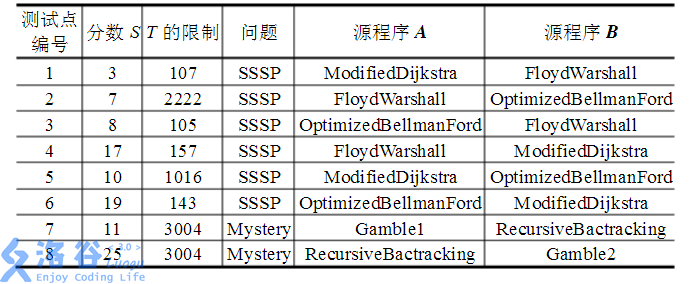
参见下表。表中每一行描述了一个子任务。其中前六个子任务与单源最短路相关,子任务 7,8 与神秘问题相关。每个任务所占分数见下表。
对于每个子任务,你的程序给出的输入 X X X A A A B B B X X X X X X F F F S , T S,T S , T
S × min { T / F , 1 } S \times \min\{T / F, 1\}
S × min { T / F , 1 }
也就是说,如果你的测试数据 X X X T T T
你需要把你的 8 8 8 1.txt ~ 8.txt。对于每个子任务 X X X
如果未提交数据,则不得分;
若数据不满足输入格式要求,则不得分;
对源程序 A A A
对源程序 B B B
题目提供的所有源代码均会维护一个计数器来统计程序的操作次数。在源程序的运行过程中,当该计数器超过了 1 0 6 10^6 1 0 6
问题 1:单源最短路(SSSP)
给定一个带权有向图 G G G G G G s s s t t t p ( s , t ) p(s, t) p ( s , t ) G G G s s s t t t s s s t t t p ( s , t ) = 1 0 9 p(s, t)=10^9 p ( s , t ) = 1 0 9 G G G Q Q Q ( s 1 , t 1 ) , ( s 2 , t 2 ) , … , ( s Q , t Q ) (s_1, t_1), (s_2, t_2), \dots, (s_Q, t_Q) ( s 1 , t 1 ) , ( s 2 , t 2 ) , … , ( s Q , t Q ) Q Q Q p ( s 1 , t 1 ) , p ( s 2 , t 2 ) , ⋯ , p ( s Q , t Q ) p(s_1, t_1), p(s_2 , t_2), \cdots, p(s_Q, t_Q) p ( s 1 , t 1 ) , p ( s 2 , t 2 ) , ⋯ , p ( s Q , t Q )
问题 2:神秘问题
给定一个包含 V V V E E E G G G [ 0 , X − 1 ] [0, X-1] [ 0 , X − 1 ] X X X
输入格式
问题 1
输入数据包含两部分,其中第一部分使用邻接表来描述带权有向图 G G G G G G
数据第一部分的第一行包含一个整数 V V V G G G 0 , 1 , ⋯ , V − 1 0, 1, \cdots, V - 1 0 , 1 , ⋯ , V − 1
接下来 V V V n i n_i n i i i i n i n_i n i ( j , w ) (j, w) ( j , w ) i i i j j j w w w
数据第二部分的第一行包含一个整数 Q Q Q
接下来 Q Q Q k k k s k , t k s_k, t_k s k , t k
同一行中任意两个相邻的整数均需要至少一个空格将他们分开。除此之外,数据还需满足如下条件:
0 < V ≤ 300 0 < V \leq 300 0 < V ≤ 3 0 0 n i n_i n i 0 ≤ j < V 0 \leq j < V 0 ≤ j < V ∣ w ∣ < 1 0 6 \lvert w \rvert < 10^6 ∣ w ∣ < 1 0 6 0 ≤ ∑ i = 0 V − 1 n i ≤ 5000 0 \leq \sum\limits_{i = 0}^{V-1} n_i \leq 5000 0 ≤ i = 0 ∑ V − 1 n i ≤ 5 0 0 0 0 < Q ≤ 10 0 < Q \leq 10 0 < Q ≤ 1 0 0 ≤ s k < V , 0 ≤ t k < V 0 \leq s_k < V, 0 \leq t_k < V 0 ≤ s k < V , 0 ≤ t k < V 图中没有负权圈。
问题 2
输入数据的第一行包含两个整数 V V V E E E
接下来 E E E a , b a, b a , b a a a b b b G G G
70 < V < 1000 70 < V < 1000 7 0 < V < 1 0 0 0 1500 < E < 1 0 6 1500 < E < 10^6 1 5 0 0 < E < 1 0 6 对于所有的边 ( a , b ) (a, b) ( a , b ) a ≠ b , 0 ≤ a < V , 0 ≤ b < V a \neq b, 0 \leq a < V, 0 \leq b < V a = b , 0 ≤ a < V , 0 ≤ b < V
伪代码:
接下来是我们提供的所有程序的伪代码;变量 counter 近似描述出了程序的运行时间。评测时将会使用这些伪代码的 C++ 版本来进行评测。
FloydWarshall
1 2 3 4 5 6 7 8 9 counter = 0 for k = 0 to V-1 for i = 0 to V-1 for j = 0 to V-1 increase counter by 1 ; M[i][j] = min (M[i][j], M[i][k] + M[k][j]); for each query p (s,t) output M[s][t] ;
OptimizedBellmanFord
1 2 3 4 5 6 7 8 9 10 11 12 13 14 counter = 0 for each query p (s,t); dist[s] = 0 ; loop V-1 times change = false ; for each edge (u,v) in L increase counter by 1 ; if dist[u] + weight (u,v) < dist[v] dist[v] = dist[u] + weight (u,v); change = true ; if change is false break from the outermost loop; output dist[t];
ModifiedDijkstra
1 2 3 4 5 6 7 8 9 10 11 12 13 14 15 counter = 0 ; for each query p (s,t) dist[s] = 0 ; pq.push (pair (0 , s)); while pq is not empty increase counter by 1 ; (d, u) = the top element of pq; remove the top element from pq; if (d == dist[u]) for each edge (u,v) in L if (dist[u] + weight(u,v) ) < dist[v] dist[v] = dist[u] + weight (u,v); insert pair (dist[v], v) into the pq ; output dist[t];
Gamble1
1
2
3
Sets X = V; labels vertex i in [0. .V-1 ] with i; Sets counter = 0 ;
Gamble2
1
2
3
Sets X = V; labels vertex i in [0. .V-1 ] with i; Sets counter = 1000001 ;
RecursiveBacktracking
1
2
3
4
5
This algorithm tries X from 2 to V one by one and stops at the first valid X. For each X, the backtracking routine label vertex 0 with 0 , then for each vertex u that has been > assigned a label, the backtracking routine tries to assign the smallest possible label up to label X-1 to its neighbor v, and backtracks if necessary.
1 2 3 4 5 6 7 8 9 10 11 12 13 14 15 16 17 18 19 20 21 22 23 24 25 26 27 28 29 30 31 32 33 34 35 36 37 38 39 40 41 42 43 44 #include <algorithm> #include <cstdio> using namespace std;int i, j, k, V, n, w, M[300 ][300 ], counter, Q, s, t;int main () scanf ("%d" , &V); for (i = 0 ; i < V; i++) for (j = i+1 ; j < V; j++) M[i][j] = M[j][i] = 1000000000 ; for (i = 0 ; i < V; i++) M[i][i] = 0 ; for (i = 0 ; i < V; i++) { scanf ("%d" , &n); while (n--) { scanf ("%d %d" , &j, &w); M[i][j] = min (M[i][j], w); } } counter = 0 ; for (k = 0 ; k < V; k++) for (i = 0 ; i < V; i++) for (j = 0 ; j < V; j++) { counter++; if (counter > 1000000 ) { printf ("TLE because iteration counter > 1000000\n" ); return 1 ; } M[i][j] = min (M[i][j], M[i][k] + M[k][j]); } scanf ("%d" , &Q); while (Q--) { scanf ("%d %d" , &s, &t); printf ("%d\n" , M[s][t]); } printf ("The value of counter is: %d\n" , counter); return 0 ; }
1 2 3 4 5 6 7 8 9 10 11 12 13 14 15 16 17 18 19 20 21 22 23 24 25 26 27 28 29 30 31 32 33 34 35 36 37 38 39 40 41 42 43 44 45 46 47 48 49 50 51 52 53 54 55 56 57 58 59 60 61 62 63 64 65 66 67 68 69 70 71 72 73 74 75 76 77 78 79 80 81 82 83 84 85 86 87 88 89 90 91 92 93 94 95 96 97 98 99 100 101 102 103 104 105 106 107 108 109 110 111 112 113 114 115 116 117 118 119 120 121 122 123 124 125 126 127 128 129 130 131 132 133 134 135 136 137 138 139 #include <algorithm> #include <cstdio> #include <iostream> #include <vector> #include <queue> using namespace std;typedef pair<int , int > IntPair;typedef vector<IntPair> VectorIntPair;#define INF 1000000000 int i, j, V, n, w, counter, Q, s, t, d, u;vector<VectorIntPair> AdjList; int main () scanf ("%d" , &V); AdjList.assign (V, VectorIntPair ()); for (i = 0 ; i < V; i++) { scanf ("%d" , &n); while (n--) { scanf ("%d %d" , &j, &w); AdjList[i].push_back (IntPair (j, w)); } } counter = 0 ; scanf ("%d" , &Q); while (Q--) { scanf ("%d %d" , &s, &t); vector<int > dist (V, INF) ; dist[s] = 0 ; priority_queue< IntPair, vector<IntPair>, greater<IntPair> > pq; pq.push (IntPair (0 , s)); while (!pq.empty ()) { counter++; if (counter > 1000000 ) { printf ("TLE because iteration counter > 1000000\n" ); return 1 ; } IntPair front = pq.top (); pq.pop (); d = front.first; u = front.second; if (d == dist[u]) { for (j = 0 ; j < (int )AdjList[u].size (); j++) { IntPair v = AdjList[u][j]; if (dist[u] + v.second < dist[v.first]) { dist[v.first] = dist[u] + v.second; pq.push (IntPair (dist[v.first], v.first)); } } } } printf ("%d\n" , dist[t]); } printf ("The value of counter is: %d\n" , counter); return 0 ; }
1 2 3 4 5 6 7 8 9 10 11 12 13 14 15 16 17 18 19 20 21 22 23 24 25 26 27 28 29 30 31 32 33 34 35 36 37 38 39 40 41 42 43 44 45 46 47 48 49 50 51 52 53 54 55 56 57 58 59 60 61 62 63 64 #include <algorithm> #include <cstdio> #include <iostream> #include <vector> using namespace std;typedef pair<int , int > IntPair;typedef vector<IntPair> VectorIntPair;#define INF 1000000000 int i, j, u, V, n, w, Q, counter, s, t;vector<VectorIntPair> AdjList; bool change;int main () scanf ("%d" , &V); AdjList.assign (V, VectorIntPair ()); for (i = 0 ; i < V; i++) { scanf ("%d" , &n); while (n--) { scanf ("%d %d" , &j, &w); AdjList[i].push_back (IntPair (j, w)); } } counter = 0 ; scanf ("%d" , &Q); while (Q--) { scanf ("%d %d" , &s, &t); vector<int > dist (V, INF) ; dist[s] = 0 ; for (i = 0 ; i < V-1 ; i++) { change = false ; for (u = 0 ; u < V; u++) for (j = 0 ; j < (int )AdjList[u].size (); j++) { counter++; if (counter > 1000000 ) { printf ("TLE because iteration counter > 1000000\n" ); return 1 ; } IntPair v = AdjList[u][j]; if (dist[u] + v.second < dist[v.first]) { dist[v.first] = dist[u] + v.second; change = true ; } } if (!change) break ; } printf ("%d\n" , dist[t]); } printf ("The value of counter is: %d\n" , counter); return 0 ; }
1 2 3 4 5 6 7 8 9 10 11 12 13 14 15 16 17 18 19 20 #include <cstdio> using namespace std;int i, a, b, V, E;int main () scanf ("%d %d" , &V, &E); for (i = 0 ; i < E; i++) scanf ("%d %d" , &a, &b); printf ("%d\n" , V); printf ("%d" , 0 ); for (i = 1 ; i < V; i++) printf (" %d" , i); printf ("\n" ); printf ("The value of counter is: %d\n" , 0 ); return 0 ; }
1 2 3 4 5 6 7 8 9 10 11 12 13 14 15 16 17 18 19 20 #include <cstdio> using namespace std;int i, a, b, V, E;int main () scanf ("%d %d" , &V, &E); for (i = 0 ; i < E; i++) scanf ("%d %d" , &a, &b); printf ("%d\n" , V); printf ("%d" , 0 ); for (i = 1 ; i < V; i++) printf (" %d" , i); printf ("\n" ); printf ("TLE because iteration counter > 1000000\n" ); return 1 ; }
1 2 3 4 5 6 7 8 9 10 11 12 13 14 15 16 17 18 19 20 21 22 23 24 25 26 27 28 29 30 31 32 33 34 35 36 37 38 39 40 41 42 43 44 45 46 47 48 49 50 51 52 53 54 55 56 57 58 59 60 61 62 63 64 65 66 67 68 69 70 71 72 73 74 75 76 77 78 79 80 #include <algorithm> #include <cstdio> #include <vector> using namespace std;typedef vector<int > vi;#define INF 1000000000 int i, a, b, V, E, counter, X;vector<vi> AdjList; vi cur, ans; bool found;void backtrack (int u, int label) if (found) return ; counter++; cur[u] = label; if (u == V - 1 ) { found = true ; ans.assign (V, 0 ); for (int j = 0 ; j < V; j++) ans[j] = cur[j]; return ; } vi ok (X, 1 ) ; for (int j = 0 ; j < (int )AdjList[u+1 ].size (); j++) { counter++; if (counter > 1000000 ) return ; int v = AdjList[u+1 ][j]; if (cur[v] != -1 ) ok[cur[v]] = false ; } for (int j = 0 ; j < X; j++) if (ok[j]) backtrack (u+1 , j); } int main () scanf ("%d %d" , &V, &E); AdjList.assign (V, vi ()); for (i = 0 ; i < E; i++) { scanf ("%d %d" , &a, &b); AdjList[a].push_back (b); AdjList[b].push_back (a); } found = false ; counter = 0 ; for (X = 2 ; X <= V; X++) { cur.assign (V, -1 ); backtrack (0 , 0 ); if (found) break ; if (counter > 1000000 ) { printf ("TLE\n" ); return 1 ; } } printf ("%d\n" , X); printf ("%d" , ans[0 ]); for (i = 1 ; i < V; i++) printf (" %d" , ans[i]); printf ("\n" ); printf ("The value of counter is: %d\n" , counter); return 0 ; }
Floyd 算法复杂度恒定 O ( V 3 ) O(V^3) O ( V 3 ) 0 0 0 100 100 1 0 0 F = 104 F=104 F = 1 0 4
代码:
1 2 3 4 5 6 7 8 9 10 11 12 #include <bits/stdc++.h> using namespace std;int main () freopen ("1.txt" ,"w" ,stdout); int n=101 ; cout<<n<<"\n" ; for (int i=1 ;i<=n;i++){ cout<<0 <<"\n" ; } cout<<1 <<"\n" <<"1 2" <<"\n" ; return 0 ; }
Floyd 算法复杂度恒定 O ( V 3 ) O(V^3) O ( V 3 ) V ≤ 100 V\le 100 V ≤ 1 0 0
Bellman 算法复杂度 O ( V E ) O(VE) O ( V E ) 恶意 操控边的顺序。
这样就可以卡掉 Bellman 了。
代码:
1 2 3 4 5 6 7 8 9 10 11 12 13 14 15 16 17 18 19 20 21 22 23 24 25 26 27 28 29 30 #include <bits/stdc++.h> using namespace std;#define pii pair<int,int> #define mk make_pair #define pb push_back signed main () freopen ("2.txt" ,"w" ,stdout); int tot=(2222 -22 -294 -5 )/2 ; int n=100 ; cout<<n<<"\n" ; cout<<"0\n" ; for (int i=1 ;i<n;++i){ vector<pii>v; v.pb (mk (i-1 ,1 )); for (int j=0 ;j<n&&tot;++j){ if (j==i-1 ||j==i)continue ; v.pb (mk (j,666 )); --tot; } cout<<v.size ()<<"\n" ; for (pii p:v)cout<<p.first<<" " <<p.second<<" " ; cout<<"\n" ; } cout<<"10\n" ; for (int i=1 ;i<=10 ;++i)cout<<n-1 <<" 0" <<"\n" ; return 0 ; }
跟 Test 1 一样。
观察 Dijkstra 的代码,发现出题人给定的不要 $&.%…#@# 代码中忽略了 priority_queue 的复杂度 !
也就是说,在正权图中, Dijkstra 的复杂度为 O ( V ) O(V) O ( V )
那么为了卡掉 Dijkstra ,只能通过引入负权来解决。
首先,在负权图中的 Dijkstra 相当于一个启发式搜索 ,换句话说,也就是贪心 。
贪心最大的问题是目光短浅,只考虑当下。也就是说,我可以通过引入负权图来使得当下不优秀的选择 在以后会变成更优的选择 ,并来优化之前的最优选择 。
把这个东西的结构写出来长这样:
这是一个三角的结构,可以发现如果在 0 0 0 k k k 2 k 2k 2 k
那么把这个结构嵌套在一起 k k k O ( 2 k ) O(2^k) O ( 2 k )
我一开始这样想,发现这样做边权的增长也是 O ( 2 k ) O(2^k) O ( 2 k ) 多测 ,并且这个结构的常数极大。事实上边权迭代到 32768 32768 3 2 7 6 8
文件:
1 2 3 4 5 6 7 8 9 10 11 12 13 14 15 16 17 18 19 20 21 22 23 24 25 26 27 28 29 30 31 32 33 34 35 36 37 38 39 40 41 42 43 44 45 32 1 31 1 2 0 0 2 1 1 0 -2 2 1 0 4 2 1 1 -4 2 3 0 6 4 1 3 -8 2 5 0 8 8 1 5 -16 2 7 0 10 16 1 7 -32 2 9 0 12 32 1 9 -64 2 11 0 14 64 1 11 -128 2 13 0 16 128 1 13 -256 2 15 0 18 256 1 15 -512 2 17 0 20 512 1 17 -1024 2 19 0 22 1024 1 19 -2048 2 21 0 24 2048 1 21 -4096 2 23 0 26 4096 1 23 -8192 2 25 0 28 8192 1 25 -16384 2 27 0 30 16384 1 27 -32768 0 10 29 0 29 0 29 0 29 0 29 0 29 0 29 0 29 0 29 0 29 0
这样做有 F = 146 F=146 F = 1 4 6
同 Test 2 。
如果你看了 Test4 的 counter 计数,就会发现 counter>1300000 ,那么砍掉两次询问后有 counter>1040000 且 F = 142 F=142 F = 1 4 2
这个和后面的 Test 8 都太水了,甚至不如 Test 2&5 ,结果分数还这么高。
这里的 Gamble1 是一个一定不超时的程序,而 Search 是一个暴力程序,思想是暴力枚举 X X X
容易发现要卡掉 Search 只需要让 X X X X X X 所有 可能性。
那么完全图是一个很好的选择。
通过计算可以得到 K 55 K_{55} K 5 5 1485 1485 1 4 8 5
代码:
1 2 3 4 5 6 7 8 9 10 11 12 13 14 15 16 17 18 19 #include <bits/stdc++.h> using namespace std;const int N=110 ;int main () freopen ("7.txt" ,"w" ,stdout); cout<<"71 1501\n" ; int cnt=0 ; for (int i=0 ;i<55 ;i++)for (int j=0 ;j<55 ;j++){ if (i>=j)continue ; cnt++; cout<<i<<' ' <<j<<"\n" ; } for (int i=55 ;i<71 &&cnt<1501 ;i++)for (int j=55 ;j<71 &&cnt<1501 ;j++){ if (i>=j)continue ; cnt++; cout<<i<<' ' <<j<<"\n" ; } return 0 ; }
这里的 Gamble2 是一个一定超时的程序,所以这里我们只需要让 Search 通过就行。
通过 Test 7 的分析,我们发现答案 X X X
那么这里只需要让 X X X
X X X 2 2 2
那么只需要构造一个左边 V 1 V_1 V 1 V 2 V_2 V 2 V 1 + V 2 > 70 V_1+V_2>70 V 1 + V 2 > 7 0
我这里选择完全二分图 ,刚好 1501 = 19 × 79 1501=19\times 79 1 5 0 1 = 1 9 × 7 9 19 19 1 9 79 79 7 9
代码:
1 2 3 4 5 6 7 8 9 10 11 12 13 #include <bits/stdc++.h> using namespace std;const int N=110 ;int main () freopen ("8.txt" ,"w" ,stdout); cout<<"98 1501\n" ; for (int i=0 ;i<19 ;i++){ for (int j=19 ;j<98 ;j++){ cout<<i<<' ' <<j<<"\n" ; } } return 0 ; }
“为什么要攀登?因为山就在那里。”