Top Tree Top Trees 领先® WZH 2026-10-04 2026-10-04 你要在 O ( n log n ) \mathcal{O}(n\log n) O ( n log n )
给 1 ∼ x 1\sim x 1 ∼ x + 1 +1 + 1
求 1 ∼ x 1\sim x 1 ∼ x
最经典的解法当然是 O ( log 2 n ) \mathcal{O}(\log^2n) O ( log 2 n )
想一想树剖的做法有没有什么优化的空间:
给每一个重链单独开一个线段树,这样常熟更小。
对于每一个线段树,我们希望比较“重”的节点深度更小一点,因为在到达这个节点之前我们付出了更大的代价。
那么,我们可以在建立线段树的时候,不再从区间中点分治,而是带权分治——权值为 s z x − s z s o n x sz_x-sz_{son_x} s z x − s z s o n x
那么我们从某一个节点往上跳,若经过轻边,则子树大小必然翻倍。若经过重边,由于带权分治,子树大小依然翻倍。
于是树高 O ( log n ) \mathcal{O}(\log n) O ( log n )
那么我们就完成了这一优化。
经典的例题是 [LNOI2014] LCA 。这里放一下其维护链加链和的代码:
::::success[全局平衡二叉树]
1
2
3
4
5
6
7
8
9
10
11
12
13
14
15
16
17
18
19
20
21
22
23
24
25
26
27
28
29
30
31
32
33
34
35
36
37
38
39
40
41
42
43
44
45
46
47
48
49
50
51
52
53
54
55
56
57
58
59
60
61
62
63
64
65
66
67
68
69
70
71
72
73
void dfs (int x,int fa) sz[x]=1 ; for (int i=0 ;i<v[x].size ();i++){ int u=v[x][i]; if (u==fa)continue ; dfs (u,x); sz[x]+=sz[u]; if (sz[u]>sz[son[x]])son[x]=u; } } int cbuild (int ql,int qr) int l=ql,r=qr; while (r-l>1 ){ int mid=(l+r)>>1 ; if (2 *(bs[mid]-bs[ql])<=(bs[qr]-bs[ql]))l=mid; else r=mid; } int x=b[l]; ss[x]=qr-ql; if (ql<l){ ls[x]=cbuild (ql,l); f[ls[x]]=x; } if (l+1 <qr){ rs[x]=cbuild (l+1 ,qr); f[rs[x]]=x; } return x; } int build (int x,int fa) int y=x,Fa=fa; do { for (int u:v[y]){ if (u!=Fa&&u!=son[y])f[build (u,y)]=y; } }while (Fa=y,y=son[y]); y=0 ; do { b[y++]=x; bs[y]=bs[y-1 ]+sz[x]-sz[son[x]]; }while (x=son[x]); return cbuild (0 ,y); } void change (int x) int t=1 ,z=0 ; while (x){ s[x]+=z;s[x]%=P; if (t){ a[x]++;a[x]%=P; if (rs[x])a[rs[x]]=(a[rs[x]]-1 +P)%P; z+=1 +ss[ls[x]]; s[x]-=ss[rs[x]];s[x]=(s[x]+P)%P; } t=(x!=ls[f[x]]); if (t&&x!=rs[f[x]])z=0 ; x=f[x]; } } int getans (int x) int t=1 ,z=0 ,res=0 ; while (x){ if (t){ res+=(s[x]-s[rs[x]]+P)%P;res%=P; res-=1ll *ss[rs[x]]*a[rs[x]]%P;res=(res+P)%P; z+=1 +ss[ls[x]]; } res+=1ll *z*a[x]%P;res%=P; t=(x!=ls[f[x]]); if (t&&x!=rs[f[x]])z=0 ; x=f[x]; } return res; }
::::
不得不承认这个数据结构精巧而无用。主要是“从下往上”这一操作太反人类了。而且由于其对于每一个重链单开一个线段树(或者说是平衡二叉树),其天然不支持子树操作(而且就连链的操作也十分复杂,甚至由于是平衡二叉树,必须特判儿子的存在性)。
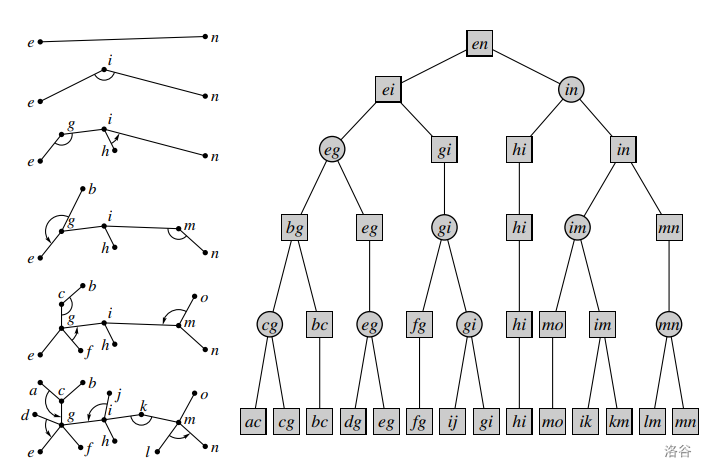
因此这个东西最大的用处就是 DDP,然而这个东西也要被 Top Tree 替代了。(不对好像静态 Top Tree 是基于他的)
Top Tree 最基本的理论:树簇理论。
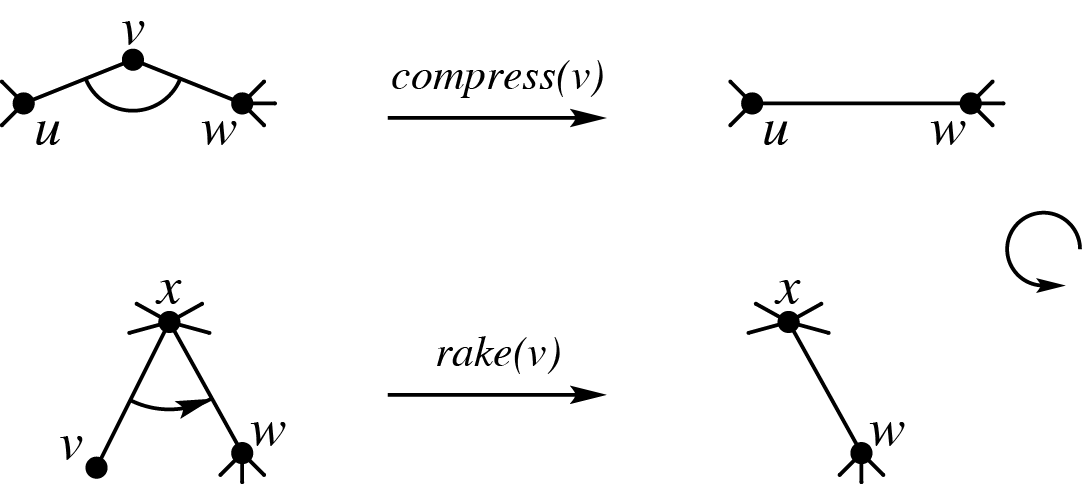
先放一张陈年老图:
其中,compress \operatorname{compress} c o m p r e s s ( a , b ) ( b , c ) → ( a , c ) (a,b)(b,c)\to (a,c) ( a , b ) ( b , c ) → ( a , c )
然后,rake \operatorname{rake} r a k e ( a , b ) ( a , c ) → ( a , c ) (a,b)(a,c)\to (a,c) ( a , b ) ( a , c ) → ( a , c )
可以证明,compress \operatorname{compress} c o m p r e s s rake \operatorname{rake} r a k e
同时,任意一个时刻,任意一个点,一定对应这原图一个连通块(这个连通块是由任意次 compress \operatorname{compress} c o m p r e s s rake \operatorname{rake} r a k e
一个树簇必然有一个深度最小的“根”,以及一个最下面的“叶子”构成,这两个点称为树簇的上下界点;换句话说,如果只 rake \operatorname{rake} r a k e
显然的,compress \operatorname{compress} c o m p r e s s rake \operatorname{rake} r a k e
::::info[例子]
例如我们可以维护树簇的上下界点的距离 l e n len l e n s z sz s z
compress ( x , y ) \operatorname{compress}(x,y) c o m p r e s s ( x , y )
l e n = l e n x + l e n y len=len_x+len_y l e n = l e n x + l e n y s z = s z x + s z y sz=sz_x+sz_y s z = s z x + s z y
rake ( x , y ) \operatorname{rake}(x,y) r a k e ( x , y )
l e n = l e n y len=len_y l e n = l e n y s z = s z x + s z y sz=sz_x+sz_y s z = s z x + s z y
::::
以上就是 Top Tree 的树簇理论的最基本的东西了。
由于 compress,rake \operatorname{compress,rake} c o m p r e s s , r a k e
那么当我修改某一条边的信息时,只需要一路 compress \operatorname{compress} c o m p r e s s rake \operatorname{rake} r a k e
一个基本的想法是树链剖分:将每一个重链上的点进行 compress \operatorname{compress} c o m p r e s s rake \operatorname{rake} r a k e O ( log 2 n ) \mathcal{O}(\log^2n) O ( log 2 n )
然而这还不够好。我们可以使用上面的全局平衡二叉树就行优化,这样树高就有 O ( log n ) \mathcal{O}(\log n) O ( log n )
【模板】动态 DP(加强版) 。
求树的最大独立集大小,点带权,每次单点修改求答案。
n , m ≤ 1 0 6 n,m\le 10^6 n , m ≤ 1 0 6
令 f x , 0 / 1 , 0 / 1 f_{x,0/1,0/1} f x , 0 / 1 , 0 / 1 x x x
则:
u = compress ( x , y ) u=\operatorname{compress}(x,y) u = c o m p r e s s ( x , y )
f u , a , b ← f x , a , c + f y , c , b f_{u,a,b}\leftarrow f_{x,a,c}+f_{y,c,b} f u , a , b ← f x , a , c + f y , c , b
u = rake ( x , y ) u=\operatorname{rake}(x,y) u = r a k e ( x , y )
f u , a , b ← f x , a , c + f y , a , b f_{u,a,b}\leftarrow f_{x,a,c}+f_{y,a,b} f u , a , b ← f x , a , c + f y , a , b
(上述状态设计和转移是因为要保证树簇的拼接点状态相同。)
::::success[代码]
1 2 3 4 5 6 7 8 9 10 11 12 13 14 15 16 17 18 19 20 21 22 23 24 25 26 27 28 29 30 31 32 33 34 35 36 37 38 39 40 41 42 43 44 45 46 47 48 49 50 51 52 53 54 55 56 57 58 59 60 61 62 63 64 65 66 67 68 69 70 71 72 73 74 75 76 77 78 79 80 81 82 83 #include <bits/stdc++.h> using namespace std;const int N=2000100 ,inf=1e9 ;using node=array<array<int ,2 >,2 >;using pii=pair<int ,int >;using sti=vector<pii>::iterator;int n,m,tot,ls[N],rs[N],f[N],F[N];int sz[N],son[N],ty[N];node a[N]; vector<int >v[N]; node rake (node &a,node &b) { node c; for (int i=0 ;i<2 ;i++)for (int j=0 ;j<2 ;j++) c[i][j]=max (a[i][0 ],a[i][1 ])+b[i][j]; return c; } node compress (node &a,node &b) { node c; for (int i=0 ;i<2 ;i++)for (int j=0 ;j<2 ;j++) c[i][j]=max (a[i][0 ]+b[0 ][j],a[i][1 ]+b[1 ][j]); return c; } void up (int p) if (ty[p])a[p]=compress (a[ls[p]],a[rs[p]]); else a[p]=rake (a[ls[p]],a[rs[p]]); } int add (int x,int y,int t) ls[++tot]=x,rs[tot]=y; f[x]=f[y]=tot;ty[tot]=t; up (tot); return tot; } void dfs (int x,int fa) sz[x]=1 ;F[x]=fa; for (int u:v[x]){ if (u==fa)continue ; dfs (u,x); sz[x]+=sz[u]; if (sz[u]>sz[son[x]])son[x]=u; } } int dc (sti l,sti r,int t) if (l+1 ==r)return l->first; int sum=0 ; for (sti it=l;it!=r;it++)sum+=it->second; sti mid=l; while (mid+1 !=r&&sum>0 )sum-=mid->second<<1 ,mid++; return add (dc (l,mid,t),dc (mid,r,t),t); } int dfs2 (int x) int y=x; vector<pii>tmp{{x,1 }}; while (son[y]){ vector<pii>ch; for (int u:v[y]) if (u!=F[y]&&u!=son[y]) ch.emplace_back (dfs2 (u),sz[u]); ch.emplace_back (son[y],1 ); tmp.emplace_back (dc (ch.begin (),ch.end (),0 ),sz[y]-sz[son[y]]); y=son[y]; } return dc (tmp.begin (),tmp.end (),1 ); } int main () scanf ("%d%d" ,&n,&m); for (int i=1 ;i<=n;i++)scanf ("%d" ,&a[i][0 ][1 ]),a[i][1 ][1 ]=-inf; for (int i=1 ,x,y;i<n;i++){ scanf ("%d%d" ,&x,&y); v[x].push_back (y); v[y].push_back (x); } dfs (1 ,0 ); tot=n; int rt=dfs2 (1 ),lst=0 ; while (m--){ int x,y; scanf ("%d%d" ,&x,&y); x^=lst,a[x][0 ][1 ]=y; while (x=f[x])up (x); printf ("%d\n" ,lst=max (a[rt][0 ][1 ],a[rt][0 ][0 ])); } return 0 ; }
::::
洪水 。
小 A 走到一个山脚下,准备给自己造一个小屋。这时候,小 A 的朋友(op,又叫管理员)打开了创造模式,然后飞到山顶放了格水。于是小 A 面前出现了一个瀑布。作为平民的小 A 只好老实巴交地爬山堵水。那么问题来了:我们把这个瀑布看成是一个 n n n 其中树根为 1 1 1 每个节点有权值(爬上去的代价)。小 A 要选择一些节点,以其权值和作为代价将这些点删除(堵上),使得根节点与所有叶子结点不连通。问最小代价。不过到这还没结束。小 A 的朋友觉得这样子太便宜小 A 了,于是他还会不断地修改地形,使得某个节点的权值发生变化。不过到这还没结束。小 A 觉得朋友做得太绝了,于是放弃了分离所有叶子节点的方案。取而代之的是,每次他只要在某个子树中(和子树之外的点完全无关)。于是他找到你。
令 f x , 0 / 1 , 0 / 1 f_{x,0/1,0/1} f x , 0 / 1 , 0 / 1 x x x
则:
u = compress ( x , y ) u=\operatorname{compress}(x,y) u = c o m p r e s s ( x , y )
f u , a , b ← f x , a , c + f y , c , b f_{u,a,b}\leftarrow f_{x,a,c}+f_{y,c,b} f u , a , b ← f x , a , c + f y , c , b
u = rake ( x , y ) u=\operatorname{rake}(x,y) u = r a k e ( x , y )
f u , a , b ← f x , a , c + f y , a , b f_{u,a,b}\leftarrow f_{x,a,c}+f_{y,a,b} f u , a , b ← f x , a , c + f y , a , b
这些都是简单的,主要是他求的是子树答案。
观察一下 Top Tree 树结构,容易发现,对于子树 x x x 边权 由其轻儿子构成的 rake \operatorname{rake} r a k e
1
2
3
4
5
6
7
8
int t=son[x];while (!ty[f[t]])t=f[t];node ans=a[t]; while (ty[f[t]]){ if (ls[f[t]]==t) ans=compress (ans,a[rs[f[t]]]); t=f[t]; }
PS: 注意维护的是边权,实际写的时候要加上 x x x
::::success[代码]
1 2 3 4 5 6 7 8 9 10 11 12 13 14 15 16 17 18 19 20 21 22 23 24 25 26 27 28 29 30 31 32 33 34 35 36 37 38 39 40 41 42 43 44 45 46 47 48 49 50 51 52 53 54 55 56 57 58 59 60 61 62 63 64 65 66 67 68 69 70 71 72 73 74 75 76 77 78 79 80 81 82 83 84 85 86 87 88 89 90 91 92 93 94 95 96 97 98 99 100 101 102 103 104 105 106 107 #include <bits/stdc++.h> using namespace std;#define int long long const int N=800100 ,inf=1e18 ;using node=array<array<int ,2 >,2 >;using pii=pair<int ,int >;using sti=vector<pii>::iterator;int n,m,tot,ls[N],rs[N],f[N],F[N];int sz[N],son[N],ty[N];node a[N]; vector<int >v[N]; node rake (node &a,node &b) { node c; for (int i=0 ;i<2 ;i++)for (int j=0 ;j<2 ;j++) c[i][j]=min (a[i][0 ],a[i][1 ])+b[i][j]; return c; } node compress (node &a,node &b) { node c; for (int i=0 ;i<2 ;i++)for (int j=0 ;j<2 ;j++) c[i][j]=min (a[i][0 ]+b[0 ][j],a[i][1 ]+b[1 ][j]); return c; } void up (int p) if (ty[p])a[p]=compress (a[ls[p]],a[rs[p]]); else a[p]=rake (a[ls[p]],a[rs[p]]); } int add (int x,int y,int t) ls[++tot]=x,rs[tot]=y; f[x]=f[y]=tot;ty[tot]=t; up (tot); return tot; } void dfs (int x,int fa) sz[x]=1 ;F[x]=fa; for (int u:v[x]){ if (u==fa)continue ; dfs (u,x); sz[x]+=sz[u]; if (sz[u]>sz[son[x]])son[x]=u; } if (!son[x])a[x][0 ][0 ]=inf; } int dc (sti l,sti r,int t) if (l+1 ==r)return l->first; int sum=0 ; for (sti it=l;it!=r;it++)sum+=it->second; sti mid=l; while (mid+1 !=r&&sum>0 )sum-=mid->second<<1 ,mid++; return add (dc (l,mid,t),dc (mid,r,t),t); } int dfs2 (int x) int y=x; vector<pii>tmp{{x,1 }}; while (son[y]){ vector<pii>ch; for (int u:v[y]) if (u!=F[y]&&u!=son[y]) ch.emplace_back (dfs2 (u),sz[u]); ch.emplace_back (son[y],1 ); tmp.emplace_back (dc (ch.begin (),ch.end (),0 ),sz[y]-sz[son[y]]); y=son[y]; } return dc (tmp.begin (),tmp.end (),1 ); } signed main () scanf ("%lld" ,&n); for (int i=1 ,x;i<=n;i++){ scanf ("%lld" ,&x); a[i][0 ][1 ]=x; } for (int i=1 ,x,y;i<n;i++){ scanf ("%lld%lld" ,&x,&y); v[x].push_back (y); v[y].push_back (x); } scanf ("%lld" ,&m); dfs (1 ,0 ); tot=n; int rt=dfs2 (1 ); while (m--){ char opt; int x,y; scanf (" %c%lld" ,&opt,&x); if (opt=='C' ){ scanf ("%lld" ,&y); a[x][0 ][1 ]+=y; while (x=f[x])up (x); } else { if (!son[x])printf ("%lld\n" ,a[x][0 ][1 ]); else { int t=son[x]; while (!ty[f[t]])t=f[t]; node ans=a[t]; while (ty[f[t]]){ if (ls[f[t]]==t) ans=compress (ans,a[rs[f[t]]]); t=f[t]; } printf ("%lld\n" , min ({a[x][0 ][1 ],ans[0 ][1 ],ans[0 ][0 ]})); } } } return 0 ; }
::::
链的话,和全局平衡二叉树是类似的。
应该还有其他好玩的应用,可惜我还没找出来。
维护的东西还可以是例如树的直径(维护两界点距离,树簇直径,两界点分别的树簇内最远距离)之类的东西,只需要维护好两界点状态就行。